
Kushinagar in eastern Uttar Pradesh is where the Buddha’s life ended. At
eighty years old, having walked and taught across northern India for forty-five years, he lay
down between two sal trees in a grove outside the small town of the Mallas and passed away.
Buddhists call it the Mahaparinirvana. Of the four great places of pilgrimage this is the
quietest and, for many pilgrims, the most affecting.
Why Kushinagar matters
The Buddha chose this place. The texts record that his attendant Ananda was dismayed that
his teacher would pass away in such an insignificant little town, and the Buddha explained that
it had once been a great city. His last instructions were given here, and the arrangements for
his cremation and for the division of his relics were settled here. For a pilgrim following the
Buddha’s life in order, Kushinagar is the last chapter.
The site was lost for centuries. Alexander Cunningham identified it in 1861 and 1862 as the
place of the parinirvana, and his colleague Archibald Carlleyle exposed the main stupa and
uncovered the great reclining statue in 1876. Monks had abandoned the area around 1200 CE, and
what archaeologists found were mounds.
What to see in Kushinagar
| Place | What it is | Time needed |
|---|---|---|
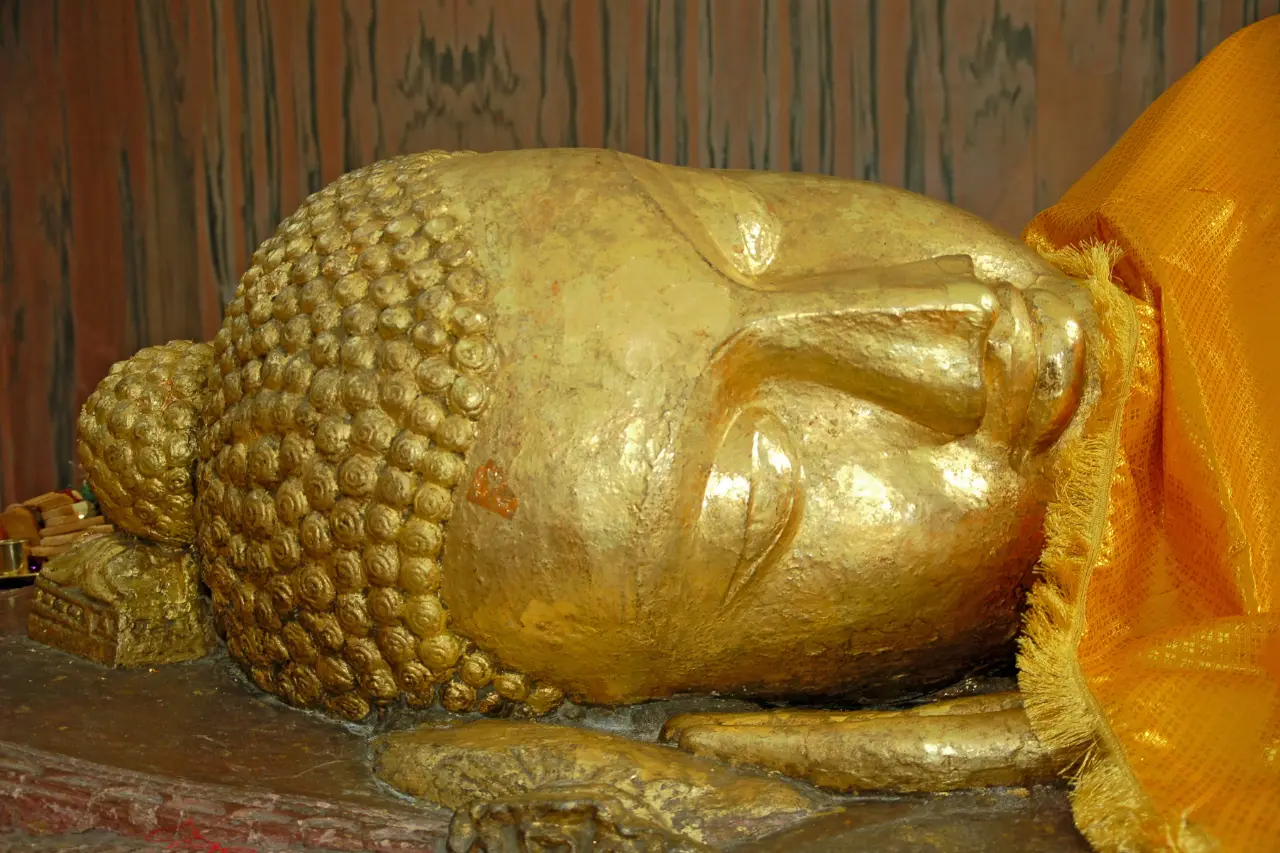
| Mahaparinirvana Temple | Holds the 6.1 metre reclining Buddha of the fifth century CE, carved from Chunar sandstone, lying on his right side with his head to the north, as the texts describe. The most important image in Kushinagar. | 1–2 hours |
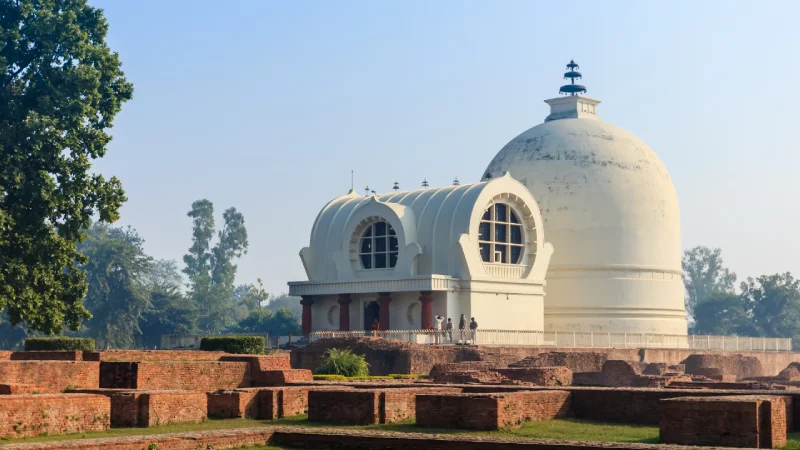
| Nirvana Stupa | Immediately behind the temple, on the same platform, built over the place of the passing and enlarged under the Guptas. | Within the temple visit |
| Ramabhar Stupa | Also called the Mukutbandhan Chaitya. The cremation site, about 1.5 kilometres east on the Kushinagar–Deoria road. A large brick mound in open ground, and the most peaceful spot in the town. | 1 hour |
| Matha Kuar shrine | A large seated Buddha in a small shrine a few hundred metres from the main temple. The inscription at its base is dated to the tenth or eleventh century. | 30 minutes |
| National temples on Buddha Marg | Indo-Japan-Sri Lanka, Chinese, Thai, Myanmar and Tibetan temples line the main road. Several run guest houses and welcome pilgrims. | 1–2 hours |
| Kushinagar Museum | Buddhist sculpture, bronzes and painted scrolls recovered from the area. | 45 minutes |
Kushinagar at a glance
| Detail | |
|---|---|
| State | Uttar Pradesh, India |
| Ancient name | Kusinara, a town of the Malla people |
| River | The Hiranyavati |
| UNESCO status | Not inscribed. The only one of the four great sites without it |
| Nearest airport | Kushinagar International (KBK), a few km from town; limited schedule |
| Practical airports | Gorakhpur and Varanasi |
| From Gorakhpur | About 50 km |
| From Lumbini | About 160–170 km, 4 hours, including the Nepal border |
| Nights we recommend | 1 |
| Best season | October to March |
How to reach Kushinagar
Kushinagar got its own international airport in 2021, and the first international flight came
in from Colombo. The schedule has stayed thin, so in practice most groups arrive by road from
Gorakhpur, which has a major railway junction and an airport, or they come across from Lumbini
in Nepal, or up from Varanasi.
On a circuit itinerary Kushinagar sits naturally between Lumbini and Vaishali or Patna, which
is how both our India and Nepal pilgrimage and
our Buddhist Circuit tour from Varanasi are routed.
Best time to visit Kushinagar
October to March. The town is at its busiest around Buddha Purnima and during the winter
pilgrimage season, when Thai, Sri Lankan, Burmese and Korean groups come through. Even then it
is calm by the standards of Bodh Gaya. Summer is severe and the monsoon makes the smaller roads
in this part of Uttar Pradesh difficult.
Things we will tell you honestly
- Kushinagar is a village-scale town, not a city. The choice of hotels is smaller than in Varanasi or Bodh Gaya, and we tell you exactly what is available for your dates rather than describing a standard that is not there.
- Many pilgrims find the Ramabhar Stupa more moving than the main temple, and many tours rush it. We allow proper time there.
- The drive in from any direction is long. For groups with elderly pilgrims we break the journey rather than doing Lumbini to Kushinagar and onward on the same day.
- Photography inside the Mahaparinirvana Temple is restricted at times, particularly when a group is chanting. Pilgrims are usually praying in there; it is not a museum.
Frequently asked questions about Kushinagar
What happened at Kushinagar?
The Buddha died here, at the age of eighty, lying between two sal trees in a grove belonging to the Malla people. Buddhists do not usually say died; they say he attained Mahaparinirvana, the final passing beyond suffering and rebirth. He was cremated a short distance away, at the spot now marked by the Ramabhar Stupa.
How old is the reclining Buddha statue?
It dates from the fifth century CE. It is 6.1 metres long, carved from Chunar sandstone, and it lies on a stone couch inside the Mahaparinirvana Temple. It was unearthed in 1876 by the archaeologist A. C. L. Carlleyle. A copper plate found at the site records that a monk named Haribala had the statue installed.
Is Kushinagar a UNESCO World Heritage Site?
No, and it is the only one of the four great sites of the Buddha’s life that is not. Lumbini was inscribed in 1997, Bodh Gaya in 2002 and Sarnath in 2026. Kushinagar remains outside the list, which has no bearing on its sacredness but does mean less funding and less publicity than the other three.
How many days do I need in Kushinagar?
One night is usually enough. The town is small and the main sites — the Mahaparinirvana Temple, the Nirvana Stupa, the Matha Kuar shrine, the Ramabhar Stupa and the national temples — can be covered on foot and by short drive in a single unhurried day.
Which airport serves Kushinagar?
Kushinagar International Airport, which opened in 2021, is a few kilometres from the town. Its flight schedule is limited and changes, so Gorakhpur, about 50 kilometres away, and Varanasi remain the practical arrival points for most itineraries.
How far is Kushinagar from Lumbini?
Roughly 160 to 170 kilometres, about four hours, and the drive includes the India–Nepal border crossing. It is the standard leg between the two, and we plan the day around the crossing rather than pretending it is quick.
The other sacred sites on the Buddhist Circuit
Bodh Gaya · Sarnath · Lumbini · Rajgir & Nalanda
All five are usually travelled together. Our Buddhist Circuit tour from Varanasi, 7-night tour from Bodh Gaya and 10-night India and Nepal pilgrimage each cover a different combination. Temple groups and monastic parties are handled separately on our group pilgrimage page.
Plan your visit to Kushinagar with Travel Ocean
Travel Ocean is a tour company based in Varanasi. We have been taking pilgrim groups
and private families through these places for twelve years, which means we know the
driving times, the quiet hours at each monument and the practical problems before they
happen. Tell us your dates, how many people are travelling and where you want to start,
and we will send you a written plan and a written price. Nothing is charged until you
have both in front of you.
Call or WhatsApp +91 9648542487 |
Landline 0542-2282063 |
Email abhishek@traveloceanindia.com
Office hours 9:00 to 17:00, Monday to Saturday.