
Rajgir and Nalanda in Bihar are where Buddhism did its thinking. Rajgir was
the royal capital where the Buddha taught for several rainy seasons and where the First Buddhist
Council met after his death. Nalanda, twelve kilometres away, became the greatest centre of
Buddhist learning in the ancient world. One is where the teaching was spoken; the other is where
it was studied, debated and carried out across Asia.
Why Rajgir matters
Rajagriha was the capital of Magadha, the most powerful kingdom of the Buddha’s time, and
King Bimbisara was among his earliest royal supporters. The Buddha stayed here repeatedly. He
taught from Gridhakuta, the Vulture’s Peak, and a large number of the discourses recorded in the
Pali canon open with the words that place them on that hill or in the bamboo grove below it.
After the Buddha’s passing, several hundred monks assembled in the Saptaparni Cave, about two
kilometres southwest of the town, for what Buddhists call the First Council. Their purpose was
to recite the teachings aloud and agree what was authentic. Everything later written down in the
Pali canon runs back through that meeting. For a pilgrim, Rajgir is where the teaching was
secured.
Why Nalanda matters
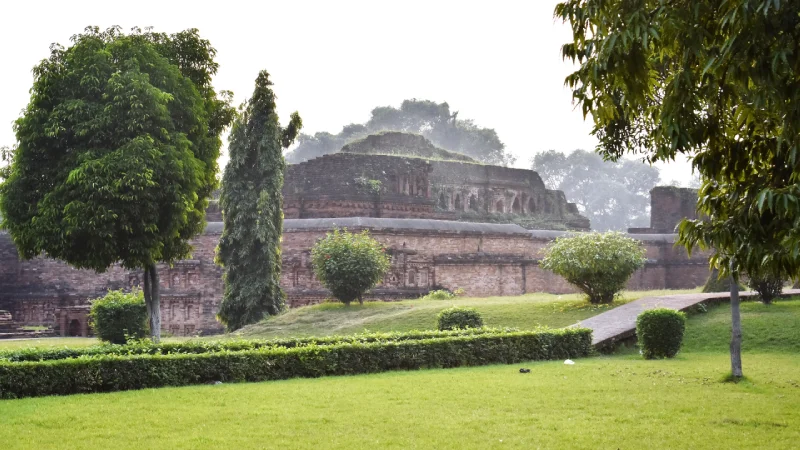
Nalanda Mahavihara was a monastery and a university at the same time. It grew from the fifth
century CE, under the patronage of the Gupta kings and their successors, into an institution that
drew students from across Asia and taught far more than scripture: grammar, logic, medicine and
mathematics were all studied here. It is widely described as the oldest university of the Indian
subcontinent.
Almost everything known about early Nalanda comes from two Chinese monks who travelled there.
Xuanzang arrived in 637 CE, returned in 642 and spent around two years in residence; Yijing came
later in the same century. Their accounts describe the libraries, the daily debates and the
teachers. The monastery was sacked around 1193 CE and abandoned. The Archaeological Survey of
India excavated the mounds in the twentieth century, and the site was inscribed on the UNESCO
World Heritage List on 15 July 2016.
What to see in Rajgir and Nalanda
| Place | What it is | Time needed |
|---|---|---|
| Gridhakuta, the Vulture’s Peak | The hill from which the Buddha taught. The climb is stepped and moderate, and the view over the valley explains why he kept coming back. | 2 hours |
| Saptaparni Cave | Site of the First Buddhist Council, about 2 km southwest of Rajgir, set into the hillside. | 1–2 hours including the walk |
| Veluvana, the Bamboo Grove | The grove King Bimbisara gave to the monastic community, among the first dwellings the sangha ever owned. | 30 minutes |
| Vishwa Shanti Stupa | The white Peace Pagoda on Ratnagiri hill, reached by a ropeway. Built by Japanese Buddhists; the ride up is part of the experience. | 1–2 hours |
| Bimbisara’s jail and the hot springs | The ruins traditionally identified as where the old king was confined by his son, and the warm springs on Vaibhavgiri still used by bathers. | 1 hour |
| Nalanda Mahavihara ruins | Monastery courtyards, cells, stairways and the great stupa of Sariputta, spread over a large excavated area. UNESCO World Heritage Site. | 2 hours |
| Nalanda Archaeological Museum | Sculpture, bronzes, seals and manuscripts recovered from the site, directly across from the ruins. | 1 hour |
| Xuanzang Memorial Hall | Built in honour of the Chinese pilgrim whose writings preserved Nalanda’s memory. | 30 minutes |
Rajgir and Nalanda at a glance
| Detail | |
|---|---|
| State | Bihar, India |
| Ancient names | Rajagriha, and Nalanda |
| UNESCO status | Nalanda Mahavihara inscribed 15 July 2016; about 23 hectares |
| Distance between them | About 12 km |
| From Bodh Gaya | About 75 km |
| From Patna | About 90 km |
| Nearest railway | Rajgir, about 11 km from Nalanda |
| Nearest airport | Patna, or Gaya for the Bodh Gaya side |
| Nights needed | Usually none; a day trip from Bodh Gaya |
| Best season | October to March |
How to reach Rajgir and Nalanda
Almost everyone comes from Bodh Gaya, about seventy-five kilometres away, and does both places
in one day. The alternative is to take them on the road to Patna, which works well if you are
flying out from there or continuing towards Vaishali and Kesariya. Rajgir has its own railway
station, and Patna airport is the main air gateway for this part of Bihar.
Both sites appear in our 7-night Buddhist
Circuit tour from Bodh Gaya, which is the itinerary that gives them proper time rather than
squeezing them into a transfer day.
Best time to visit Rajgir and Nalanda
October to March. Both sites are largely in the open, and Rajgir involves walking and a climb,
so the cooler months matter more here than at some of the other stops. Start early: by midday in
February the Nalanda ruins give you no shade at all.
Things we will tell you honestly
- Nalanda is foundations, not buildings. It is magnificent once someone shows you how the monastery worked, and dull brickwork if nobody does. Of all the sites on the circuit, this is the one where a good guide matters most.
- Gridhakuta involves a climb. It is stepped and manageable for most people, but if a member of your group cannot manage steps, say so when you book and we will plan around it.
- Doing Rajgir and Nalanda properly in one day from Bodh Gaya makes for a long day. It is worth it; it is not restful.
- The ropeway at Rajgir occasionally stops for maintenance or weather. There is a stepped path as the alternative.
- These two are the stops most often cut when an itinerary is squeezed. If the history of Buddhism interests you more than the devotional sites alone, do not let them be cut.
Frequently asked questions about Rajgir and Nalanda
What is the connection between Rajgir and the Buddha?
Rajgir, then called Rajagriha, was the capital of the kingdom of Magadha under King Bimbisara, who became one of the Buddha’s early royal patrons. The Buddha spent several rainy-season retreats here and taught from the hill called Gridhakuta, the Vulture’s Peak. A great many of the discourses in the Pali canon are set in and around this town.
Where was the First Buddhist Council held?
At the Saptaparni Cave, about two kilometres southwest of Rajgir, in the months after the Buddha’s passing. Several hundred monks gathered there to recite and agree what the Buddha had actually taught, which is how the teachings came to be fixed and transmitted.
What was Nalanda?
A Buddhist mahavihara, a great monastery that was also a centre of learning. It flourished from about the fifth to the twelfth century CE and is often called the oldest university of the Indian subcontinent. Monks studied Buddhist philosophy there alongside grammar, logic, medicine and mathematics.
Is Nalanda a UNESCO World Heritage Site?
Yes. The Archaeological Site of Nalanda Mahavihara was inscribed on the UNESCO World Heritage List on 15 July 2016, under cultural criteria four and six. The protected area covers about 23 hectares.
How do I know what Nalanda was like?
Mostly from two Chinese monks. Xuanzang, also written Hiuen Tsang, arrived in 637 CE and came back in 642, spending around two years there, and Yijing studied there later in the same century. Their written accounts are the main source for what the place looked like and how it taught.
Do Rajgir and Nalanda need an overnight stay?
Usually not. Both are commonly covered as a day trip from Bodh Gaya, about 75 kilometres away, or taken on the way to Patna. Rajgir has hotels if you want a slower pace, and the hot springs and the ropeway are reasons some travellers stay.
The other sacred sites on the Buddhist Circuit
Bodh Gaya · Sarnath · Kushinagar · Lumbini
All five are usually travelled together. Our Buddhist Circuit tour from Varanasi, 7-night tour from Bodh Gaya and 10-night India and Nepal pilgrimage each cover a different combination. Temple groups and monastic parties are handled separately on our group pilgrimage page.
Plan your visit to Rajgir and Nalanda with Travel Ocean
Travel Ocean is a tour company based in Varanasi. We have been taking pilgrim groups
and private families through these places for twelve years, which means we know the
driving times, the quiet hours at each monument and the practical problems before they
happen. Tell us your dates, how many people are travelling and where you want to start,
and we will send you a written plan and a written price. Nothing is charged until you
have both in front of you.
Call or WhatsApp +91 9648542487 |
Landline 0542-2282063 |
Email abhishek@traveloceanindia.com
Office hours 9:00 to 17:00, Monday to Saturday.